In my first post of this year I said I’d write more, “if not for engagement or feedback, then at least as an archive for myself.” I’ve mostly kept to that, if event recaps count (I’m counting them).
This one’s about something that’s been bugging me for a few weeks.
In March I ran a workshop called “Technical Writing in the Age of AI” at the Wikimedia DSDP event in Delhi (the slides are here). One section was on what writing as a practice involves, and two posts I like came up a fair bit there: Shreya Shankar’s Writing in the age of LLMs and Prashanth Rao’s framework for technical writing. Both of them use a model when they write, and both are careful about how.
So I’m in the “use the tools” camp; I even have a page about it, and this post was put together the same way. Then I read Colin Breck’s I don’t want to read what you didn’t write, which is a long way from that camp, and caught myself nodding at paragraph after paragraph.
The reading hasn’t gotten any faster
Ask any senior engineer how their week went and there’s a good chance the answer involves a review queue that won’t stop growing (agents opening PRs faster than anyone can look at them). Kailash Nadh’s Code is cheap. Show me the talk. from January (I liked the title enough to put it on one of my workshop slides) has the line I keep coming back to: “reading and critically evaluating code have become more important than learning syntax and typing it out line by line.”
Docs aren’t very different. Putting together a design doc or a PRD is a lot quicker now; sitting with one and understanding what it’s asking of you is a whole different story.
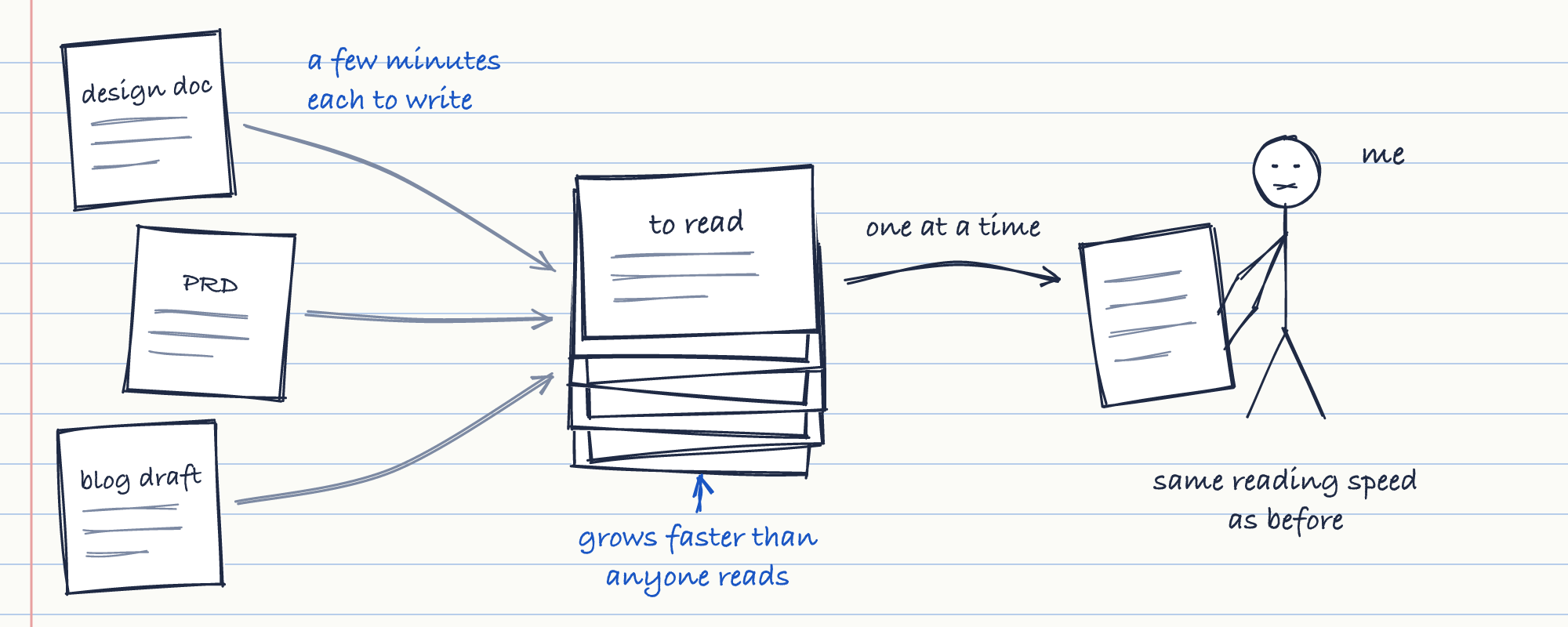
The part of Colin Breck’s post I agree with most is about context. When I’m the one prompting, I know what I asked for, what I threw away, and which files the model looked at; the output reads fine to me. Whoever opens it next has none of that. He describes that reader as “forced to read exhaustively and consider every line, peering into the internals of a machine”, which is how it feels from the receiving end.
I’ve been on the receiving end of this plenty. Plans and PR descriptions the sender hadn’t read through, blog drafts sent over for review that the author never checked, and slide decks that still had the model’s notes to whoever was drafting them, sent along for review anyway.
I still draft with help
Murat Demirbas’s Writing as a thinking tool makes the case for keeping the model out of it until the thinking’s done. For him the document is almost a by-product; the thinking happens in the writing, and a model can’t do that part for you. He quotes Leslie Lamport:
If you think without writing, you only think you’re thinking.
(I had “Writing is thinking” on a workshop slide. Lamport’s version is better.)
I’m with Murat on all of that, and I still open a chat window earlier than he’d like. Shreya’s post (the one from the workshop) has a version of this I like; she says she’s “usually sharper at critiquing than generating”, so she writes each paragraph herself first, “even if it’s ugly”, and brings a model in when she’s stuck on how to say something she already knows she wants to say. That’s close to how I work!! I’d rather get a rough version down fast and spend my energy on the edit, where I’m more useful anyway.
Prashanth’s framework post, the other one from the workshop, kept the model at arm’s length: ideas and outline by hand, a model only for polish at the end. The one he wrote a few months later, on how he writes faster with AI, has a model at every stage, drafting included. What I like is what he kept. He still checks the outline himself before any drafting starts, and ownership of the ideas and the narrative is, in his word, “non-negotiable”. That’s roughly where I’ve landed too.
A prompt’s worth
Jacob Tomlinson gave me the vocabulary for doing this well versus badly, in a post he dictated while walking his dog. He calls the bad kind extrapolation: a couple of lines go in, two thousand words come out, and the reader gets to hunt for the couple of lines.
You might as well just tweet the prompt instead of blowing it up into a piece of content.
The other kind is interpolation. You turn up with more than will fit (saved links, notes, slides, half an argument) and the model helps you cut it down.
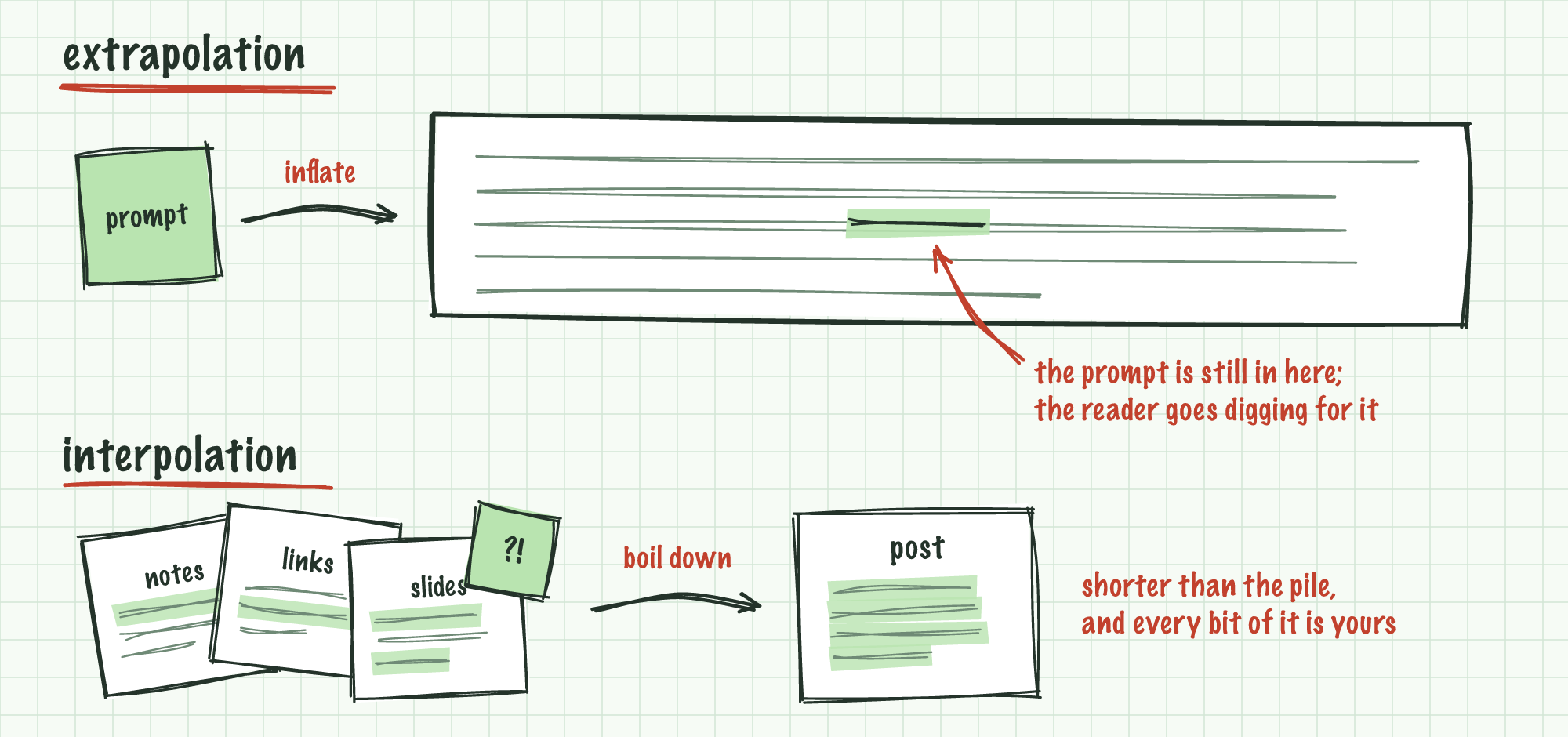
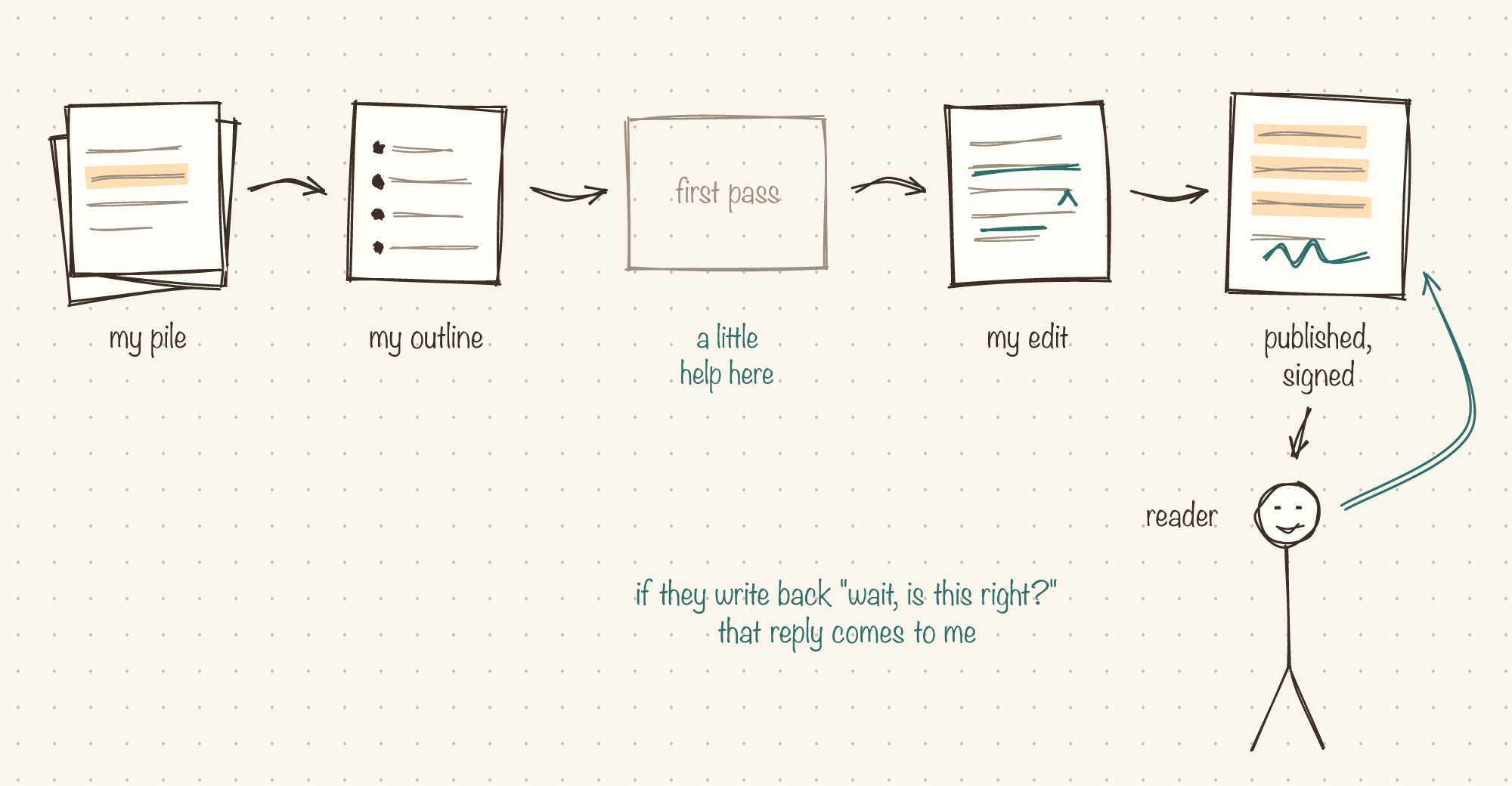
That’s also my answer to the context problem from Colin’s post, I think. If the pile was mine, what lands in front of you is a shorter version of things I know and can defend. If all I had was the prompt, you’re reading the model’s guess at what I meant.
My name’s on it
Going back to Kailash Nadh’s post from earlier; a good chunk of it is about accountability, and that’s the part I’d underline. Endless generated output is hard to value, he argues, and what gives a piece of work its worth is
the ability to hold someone accountable at least emotionally and morally, and sometimes legally, for an artefact
No model can take that off my hands. It can draft a sentence for me, but the “wait, is this right?” reply comes to me. And if rerunning the model is all I add, there isn’t much left for me to answer for. The rule on my AI page says it shorter: “if I can’t explain it in my own words, I don’t write about it.”
The same rule applies to picking up anything new; I’d much rather a model quiz me than hand me the answer.
Keeping the rough edges
Colin Breck ends I don’t want to read what you didn’t write with this:
I don’t want to live in a world where you use AI to summarize something important into unreadable text, and then I use AI in an attempt to decipher it. I want to hear you, imperfections and all. I want your interpretation of aesthetics, beauty, quality, relationship, time. I want to know how you feel. I want you to cut through and tell me what really matters. I don’t want to read a summary of facts and connections separate from experience and relationship.
I read a bit of cringe into it, even though he never uses the word. A lot of writing gets smoothed over because someone’s worried about sounding too eager, or too plain, or about a joke that won’t land. However a post gets written, I think those are the bits worth leaving in.
Also, if you’re anywhere near Chennai on 19 and 20 December: we’re running SciPy India at IIT Madras (workshops on the Saturday, talks on the Sunday), and tickets are up. Would love to see you there :)